A dev whose tokens graduated launches again. You know about a second later.
The dev's record read from the chain at that moment, the dev's own buy, every wallet that got in during the first seconds, and any wallet on your avoid list. In Telegram, on the web and in your Chrome side panel.
Get it with Pro, $99 a monthHow it works ↓What lands in your alert
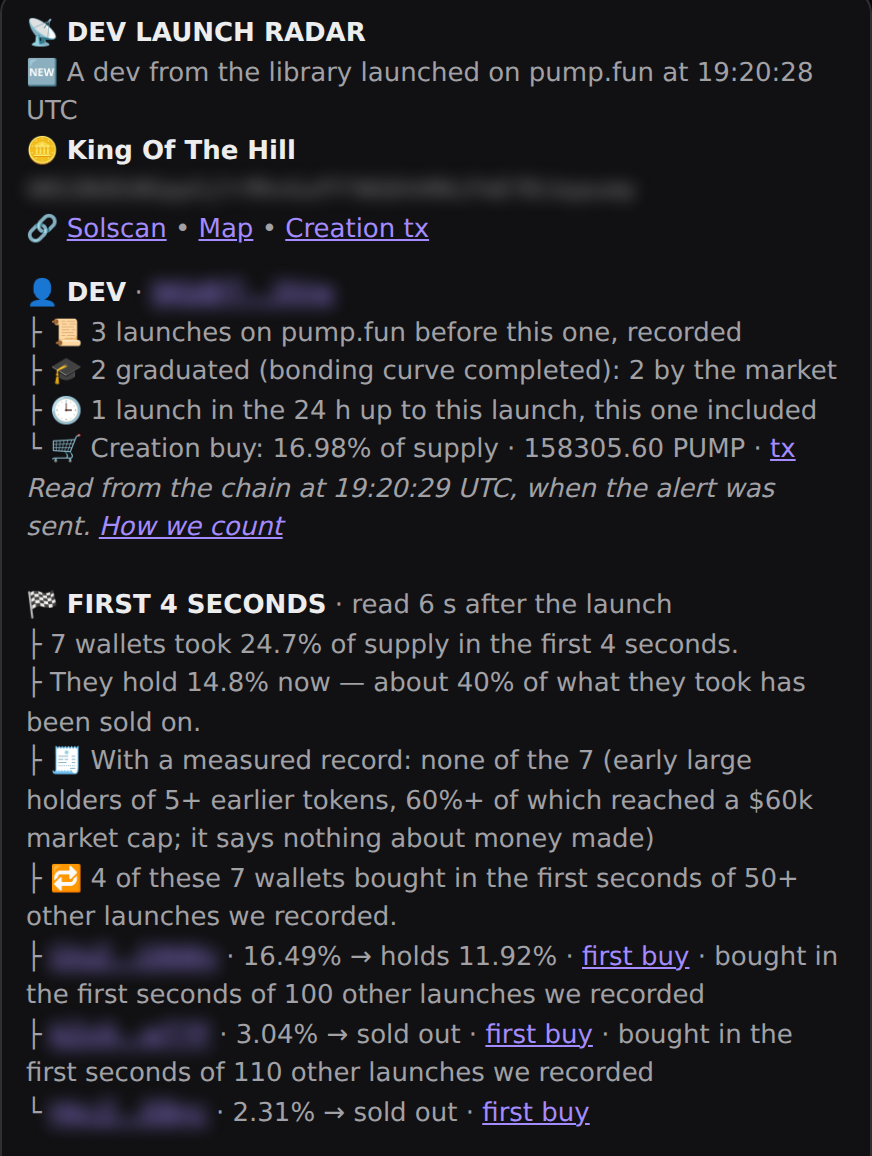
The dev's record, read at that second
Launches on pump.fun before this one, how many graduated, split into “by the market” and “at creation or by the dev”, launches in the last 24 hours, and what the dev bought in the creation transaction, with the transaction.
Every wallet in the first seconds
Every buy in the creation block and the 10 blocks after it (about 4 seconds), read from the chain: how much of the supply they took, how much they still hold and how much has already been sold on.
Who bought in the same transaction
Wallets that received their tokens inside one transaction. That is what the chain records, not a guess from timing.
Who keeps turning up early
For each early wallet, how many other launches it bought in the first seconds of, counted over every launch we recorded.
How the biggest holders got in
For the largest holders: bought from the pool, or sent their tokens by another wallet.
Your avoid list
Any wallet you have marked that is the dev, bought in the first seconds or sits among the top holders is named, and those wallets are watched live for 24 hours. If one moves, you get a separate message.
The price record
Our first read of the price, then the best and the latest, read from the bonding curve itself. Kept for every alert, the ones that fell as well as the ones that rose.
One tap to check it
Solscan, our holder map, the creation transaction and each early wallet's first buy, linked from the alert.
How it works, step by step
We see the launch
Two separate feeds record every pump.fun launch: a Helius stream and Solana's public network. Each fills what the other misses.
We match the dev
A launch by a library dev is written straight through, and the radar checks for new ones every second.
We read the dev's record from the chain, right then
Every bonding curve the dev created, and whether each one completed. Not a copy from a database that may be hours old.
You get the alert
Half of all alerts so far arrived within 0.77 seconds of the launch. Telegram, the web page, the Chrome side panel or email.
The first seconds fill in
Once the launch window is final on the chain (about 4 seconds), the same message updates itself with every early wallet.
We keep watching
The price is read every 5 seconds for the first 10 minutes, then less often for 7 days. Your avoid-list wallets are watched live for 24 hours.
Who is in the library, and what we throw out
A dev wallet is in the library when, counting the pump.fun launches we recorded, it has made 3 or more launches and at least 2, and at least half of them, graduated by the market: the bonding curve completed after the block that created the token, in a transaction the dev did not sign. Right now that is 193 dev wallets.
What we leave out on purpose:
- Graduations completed at launch or by the dev. Curves filled inside the block that created the token, or by a transaction the dev signed. A curve filled that way says nothing about whether the market wanted the token.
- pump.fun's Mayhem mode. Tokens pump.fun's own program trades. We read the flag from the bonding curve account and checked it against the creation transaction: 708 of 708 agreed. A Mayhem-mode token never counts as a graduation, and a Mayhem-mode launch is never alerted.
- Anything we could not read. A graduation we could not classify is not counted. A launch whose Mayhem flag we could not read is not alerted. If we cannot check it, it stays out.
- Market-cap milestones. The library does not use “passed $69k” or any other figure from a market-data site: only what the chain records.
We check our own alerts
Every figure in an alert links to the transaction or wallet behind it, and says when it was read. On 29-30 Oct 2026 a separate script re-read 15 alerts from the chain alone, without our database.
- The facts the chain could settle matched: the creator, the dev's buy, the launches in the last 24 hours, every early wallet's share and first transaction, the shared-transaction groups and the price record.
- Launch counts were lower than the chain for 5 devs: their missing launches were made before our records begin on 3 Sep 2026, or in the weeks before 13 Oct when we ran one launch feed instead of two. That is why the alert says “recorded” and why this page calls launch counts minimums.
- 1 dev's history was too long to re-read in full (over 30,000 transactions), so its launch count could not be settled. Its graduations matched a direct read of every bonding curve we hold for it.
- 2 alerts were sent before we excluded Mayhem mode on 29 Oct and counted some Mayhem-mode graduations. The rule changed the same evening.
Why it gives you facts and never a call
Before building it we tested the obvious idea: “a dev with a good record launches again, so buying early is a good bet.” The test rules were written down before we looked at any result.
- Data: every pump.fun launch from 5 June to 14 July 2026, 798,430 launches.
- Trade: 0.5 SOL bought 30 seconds after launch on the real bonding curve, sold 1 hour later, fees included.
| The dev's record before the launch | Average result per trade |
|---|---|
| 5+ earlier launches, 20%+ graduated | -20.3% |
| 3+ earlier launches, at least 1 graduated | -5.8% |
| 3+ earlier launches, none graduated | -2.0% |
| All launches | -3.9% |
The better the record, the worse an early buyer did, at every holding time we tested (5 minutes to 24 hours). Our library uses a stricter rule than either “good record” group above, and we have not shown that this changes the answer. So the radar gives you the facts fast, and the call is yours. We never call a dev good, proven or trusted, and no dev or token is ever marked green.
Telegram, web, Chrome and email
- Telegram: send /radar on to @TheCabalHunter_Bot. Alerts arrive in your private chat and cannot be forwarded on.
- Web: cabal-hunter.com/radar, live, with optional pop-ups or email alerts.
- Chrome extension: the 📡 button in the side panel, with optional pop-ups (version 0.5.0).
- Every alert: one tap to Solscan, our holder map, or your trading terminal.
Part of Pro, $99 a month
Pro also includes up to 50,000 scans a month, the wallet tool with 2,000 wallet lookups, an avoid list of up to 2,000 wallets, batch scans and webhooks, and every other Cabal Hunter feature.
See the Pro planLimits you should know
- Launch counts are minimums. We count the launches we recorded, starting 3 Sep 2026, and until 13 Oct we ran one launch feed, which missed about 1 launch in 8. A dev that launched before then can have more than the alert shows.
- pump.fun only.
- Some tokens are not priced in SOL. Some bonding curves are priced in another token (HYPE or PUMP, for example). The alert states the dev's buy in that token.
- “Still held” is a moment. It is read a few seconds after launch and dated. Wallets can sell a moment later.
- Not every alert is that fast. 9 of 86 alerts so far took longer than 2 seconds.
- Referral fees. Terminal buttons under an alert may earn Cabal Hunter a referral fee.
Do your own research
The radar shows you what the chain recorded, quickly, so you can make up your own mind. It is not financial advice and not a safety rating, and a dev with a clean record can still launch a token that goes to zero. Read the contract, check the holders, decide for yourself, and never put in more than you can afford to lose.
How we read the chain in general: methodology.